Open a Trust in Thailand
How trusts are treated under Thai law, the parties to a trust (settlor, trustee, beneficiary) and what a trust deed must contain. Ask our team for details.

A trust in Thailand can be used to preserve family wealth and/or provide for specific conditions under which certain assets are distributed. Our team can help you open a trust in Thailand and understand the principles and the conditions for their management and control.
A Private Trust Act bill (approved by the Cabinet in 2018) has never been enacted, so it is not yet a legal basis for the creation of these structures in the country. At the same time, the Thai Civil and Commercial Code (s.1686) provides that a trust has no effect unless created under a specific law; the only such law is the Trust for Transactions in Capital Market Act B.E. 2550 (2007).
Company registration in Thailand and Thai trust creation can be assisted by our local team of agents upon request. In this article, we highlight the main conditions for opening a trust, however, if you require more in-depth information, our team can answer your questions.
The main conditions to open a trust in Thailand
Individuals who are looking to set up a Thai trust follow the main rules for the establishment of this structure. At a minimum, a trust includes a settlor, a trustee, and one beneficiary. The relationship between the trustee and the beneficiary/beneficiaries is of a fiduciary nature.
Our team lists the main parties to a trust below:
- The settlor: the party that decides to open a trust in Thailand, individual or legal entity, which places the assets into the trust;
- The trustee: the party entrusted with the management of the assets; handles the assets according to the best interest of the beneficiaries;
- The beneficiary: one or more individuals who will receive (under certain terms or at certain dates) access to the assets placed into the trust.
A trust deed or instrument is considered null and void if it does not contain the following information:
- The names of the settlor and that of the trustee (at least one of each);
- The name(s) of the beneficiary/beneficiaries;
- The objective of the trust;
- The property/assets that are placed in the trust.
Trusts that are not created via a written instrument and those that do not have a qualified appointed trustee are also considered void. Our experts who can help you open a company in Thailand can also give you more information about the trust particulars.
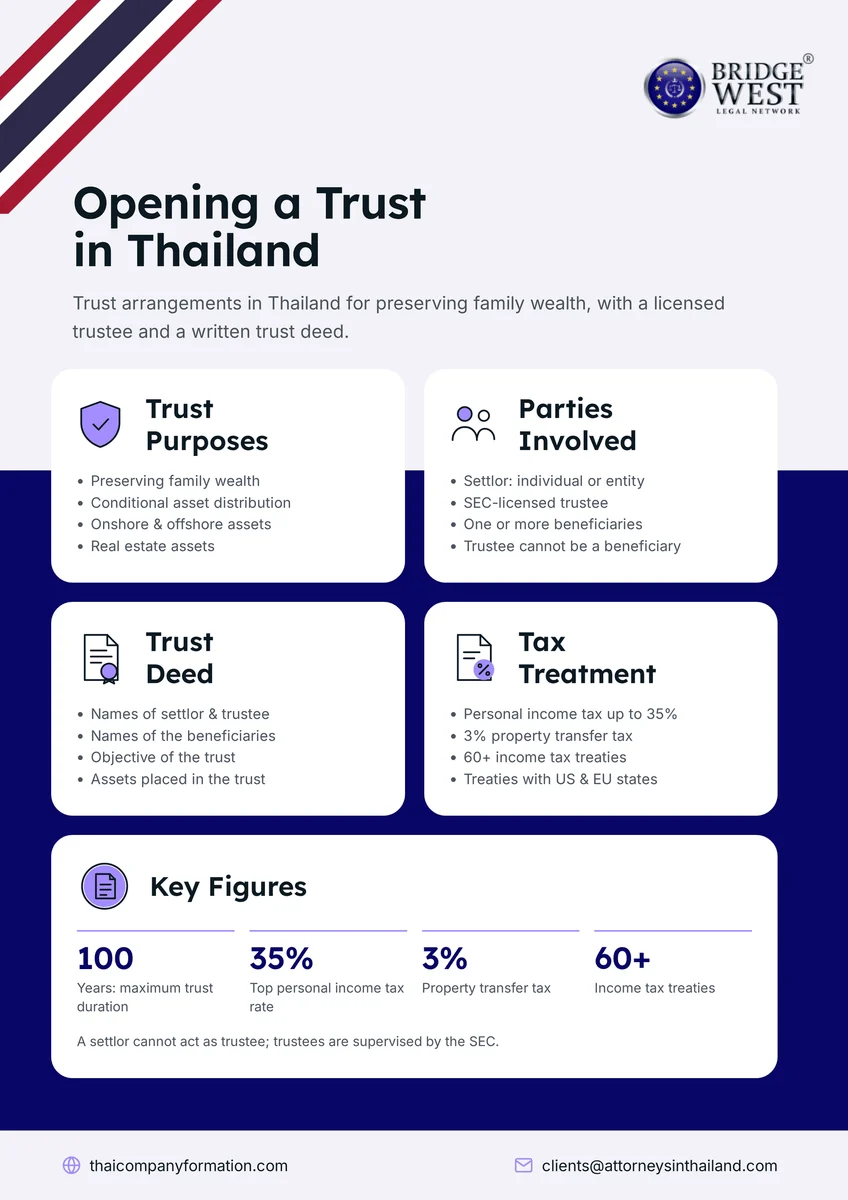
Requirements for trusts in Thailand
It is worthwhile to note that a trustee cannot be a beneficiary, and a settlor cannot act as a trustee. If you want to open a trust in Thailand, our team can give you more information about who can fulfil the mandatory roles.
Under Thai law, a trustee has to be a qualified person who is properly licensed by the Securities and Exchange Commission.
The powers and the responsibilities of the trustee are described under law, however, the settlor can describe these in the trust agreement. The trustee shall act in the best interests of the beneficiary/beneficiaries and cannot come into a conflict of interest with these parties.
The assets placed in the trust include onshore and offshore ones and can also include real estate.
How to open a trust in Thailand
Setting up a Thai trust involves drawing up a set of documents and complying with the statements that are submitted for this type of structure.
The trust deed is the founding document that includes all the relevant information about the trust, its structure, appointed parties, duration, types of assets, and information on the distribution of the said assets (as directed by the settlor).
The administration of the trust is overseen by the Securities and Exchange Commission. The purpose of the oversight is to ensure compliance under the relevant trust laws applicable in the country, to avoid trust mismanagement.
A settlor who will open a trust in Thailand cannot, according to the law, also act as the trustee. As previously mentioned, he appoints the latter, who must be a qualified person under the (draft) Private Trust bill or, for capital-market trusts, the Trust for Transactions in Capital Market Act. Qualification is proven via a licence issued by the Securities and Exchange Commission, as mentioned. The trustee cannot be a beneficiary of the trust.
A blueprint of the steps that take place when opening and managing a trust in Thailand is outlined below by our Thai company formation experts:
- The settlor sets up the trust and transfers the ownership of the assets placed within to the trustee;
- The trustee, thus entrusted with the administration of the trust, takes up their fiduciary duties and starts handling matters related to the funds and/or assets in the best interest of the beneficiaries;
- The private trust can be set up for a maximum of 100 years. However, this term is more than sufficient to fulfil the purposes commonly associated with trust creation in Thailand.
Trust supervision and oversight
The Securities and Exchange Commission not only licenses the trustee, it also handles matters related to trust documentation and general supervision. Some of the issues concerning trust oversight in Thailand include the following:
- The trustee prepares and submits the financial statements for the trust;
- The documents are drafted according to the accounting standards. These are the Thai Accounting Standards, however, the IFRS or GAAP can be consulted in matters that are not covered by these;
- The financial statement is to be audited by a SEC-approved auditor;
- The SEC, having supervisory authority, may order a trustee handling a trust in Thailand to provide additional documentation for inspection or to perform acts that are meant to prevent the mismanagement of the trust.
According to the law, the SEC has the power to supervise trusts that are used for transactions in the capital market. This means that it can issue rules, regulations, orders, and directives, it can determine the fees, and can issue guidelines.
Tax matters
Individuals who choose to open a trust in Thailand could expect further tax developments on the treatment of trusts. Presently, the following could be taken into account:
- Thailand has signed more than 60 income tax treaties and income from trusts should be subject to double taxation protection. Among the signatory states are EU countries, the USA, and others;
- The transfer of immovable property is subject to a 2% transfer fee, plus specific business tax of 3.3% or stamp duty of 0.5% (and withholding tax);
- The Thai personal income tax rate is progressive up to 35%.
For matters concerning trust taxation and reporting compliance you can reach out to our accountants in Thailand.
Foreign investors who want to know how they can open a company in Thailand can discuss these matters with our agents, in addition to or in lieu of those related to trust creation.
Contact us for more information about trusts in Thailand and the general process required for company formation in Thailand.
Jose Herrera, Attorney at Law · 8 October 2026Jose Herrera is Managing Partner and Founder of Herrera and Partners.